What Is Embodied AI? Frameworks, Hardware, and Applications
Updated: Sep 15
A digital brain cannot learn to grasp a shifting object without a physical body. This gap between digital simulation and physical reality is the frontier of modern robotics.
Embodied AI is the integration of artificial intelligence into physical systems, enabling machines to perceive, learn, and interact with the physical world. These systems combine sensory feedback, world models, and control software to help robots make closed-loop decisions in dynamic and uncertain environments.
Rather than repeating static, pre-programmed routines, robots learn from human demonstrations to perform complex tasks like robotic manipulation, mobile AI navigation, and precise teleoperation. Research teams use integrated hardware to capture high-frequency joint states and synchronized camera feeds, creating rich datasets that teach neural networks to master real-world mechanics. This transition drives the real-world applications of embodied AI, enabling machines to adapt to physical friction and safely operate alongside humans.
Understanding this shift requires a close look at the software frameworks, hardware interfaces, and data pipelines that make physical interaction possible. To explore how these robotic systems perceive, learn, and act, we must start with the foundational question: What Is Embodied AI? The answer begins with
What Is Embodied AI?
Answer: Embodied AI is the merging of artificial intelligence with physical systems. This allows machines to perceive, reason, and act within the real world, turning static models into active physical agents.
For years, standard AI lived only in virtual spaces like flat screens. Embodied AI changes this by merging digital brains with physical bodies. This lets smart systems interact with the real world directly. They do not just think; they move, touch, and learn from the messy, dynamic spaces where we live and work.
Environment | Traditional AI works on digital data. Embodied AI acts in a physical, dynamic world. |
Learning | Traditional AI learns fixed patterns. Embodied AI improves through closed-loop feedback. |
Perception | Traditional AI uses one modality. Embodied AI blends touch, vision, and sound. |
Output | Traditional AI returns predictions. Embodied AI drives physical action through motors. |
The Three Core Pillars of Embodiment
To work in a changing world, machines must do more than follow fixed loops. Research shows that embodied intelligent systems combine three key tasks to succeed. First, they use multimodal perception to see, feel, and hear their surroundings. Then, they use world models and adaptive control to predict states and guide their motors safely.
These three tasks support a closed-loop system where action feeds back into perception. This loop helps robots perform complex manipulation tasks that were once too hard. For instance, a robotic arm can now sort soft fruits or turn stiff knobs by learning from real-time touch. To see how these parts fit together, teams can look to a practical physical AI stack to link hardware and software.
The Rise of Large Multimodal Models
In the past, robot brains relied on narrow, hand-coded rules for every task. Today, large multimodal models have reshaped how researchers build physical systems. These big models can process text, images, and joint movements all at once. This means robots can understand rich commands and adapt to new tasks without a total rewrite of their code.
Using these advanced models, robots can learn from human examples. Instead of writing math formulas for every joint, researchers show the robot how to do a task. The model then learns the rules of the task and can repeat it in new settings. This makes it much easier to build smart machines that can work in messy, real-world rooms.
From Research Labs to the Real World
This model-based approach moves the field from simple lab tests to real-world applications of embodied AI in factories and homes. Modern labs now use these systems to collect training data, train their models, and run them on physical robots with ease. By focusing on practical workflows, teams can go from a simple idea to a working robot much faster than before.
Why Does Embodiment Matter for Intelligence?
Answer: True intelligence needs a physical body to interact with the world. Without a physical form, an agent cannot gather direct feedback from its actions. Physical embodiment allows an AI system to learn through trial, error, and real sensory feedback. This feedback bridges the gap between pure calculation and real-world action.
The Shift to Sensorimotor Learning
For a long time, artificial intelligence research focused on games and language. But humans and animals learned to navigate their world long before they learned to talk. This idea is the basis of the embodied Turing test, which guides research in embodied ai.
Instead of testing chess or text, this test challenges AI models to interact with the physical world like real animals do. This shift values skills shaped by 500 million years of evolution, such as vision and movement, over language alone. To pass this test, an artificial agent must use sensors and motors to master its environment.
Foundations of Physical Feedback
Modern physical systems build on behavioral robotics and classical cognitive architectures. In the past, researchers tried to program every rule of movement. Today, research shows that new Multimodal Large Models and World Models are changing how we build these systems.
These new models do not just calculate. They learn how their actions change their surroundings. By taking actions and receiving instant feedback, systems learn to adapt to uncertain spaces. They build a map of the world through constant interaction.
This closed-loop design makes robots useful for real work instead of simple lab demos. It forms the basis of a practical physical AI stack, where physical hardware and AI algorithms work together.
Connecting Neuroscience and NeuroAI
Much of this work is inspired by neuroscience. This link between brain science and machine learning is known as NeuroAI. In the past, studying the brain has helped researchers build better computer systems.
For example, finding how animal brains process vision led to the deep neural networks we use today. NeuroAI focuses on making AI better at things that animals do well, such as vision and reward-based learning. By looking at how brains compute, teams can build more robust models. This knowledge helps us construct robotic brains that can learn from their errors in real time.
How Embodied AI Works: Sensing, Reasoning, and Action
Answer: Embodied AI works by running a continuous loop of sensing, reasoning, and action. It collects data through sensors to build a predictive world model and plan its next move. The system then executes that plan using physical actuators with closed-loop feedback to adapt to changes.
Multimodal perception and sensing
To interact with our world, a robot must first perceive its surroundings. It uses cameras and touch sensors to gather real-time data. Blending these different inputs gives the system a clear view of its workspace. This rich data feeds into the brain of the robot to guide its next steps.
For example, when a robotic arm grabs a cup, it needs more than just vision. It must also feel how heavy the cup is. If the cup starts to slip, touch sensors send a quick signal. Blending vision and touch allows the robot to handle delicate items without breaking them.
Predictive reasoning with world models
Once the robot gathers data, it must make sense of it. The system uses a world model to think about what is happening around it. These world models predict future states in dynamic and changing areas. This helps the machine plan its moves before it acts.
To train these smart systems, developers often use digital twins. These are virtual copies of the real world with exact physical traits. Engineers use them to make synthetic data to train the robot alongside real-world facts.
Training in a simulation is fast and safe. A robot can try a task thousands of times in a virtual space without any risk. If it makes a mistake, it can restart in a split second. This practice helps the brain of the robot get much better at solving hard tasks.
Closed-loop control and action
The final step in the loop is action, as the robot sends signals to its joints to move. As it moves, the system must check if its plan is working. It uses closed-loop interaction to adjust to changes in the environment. This means the robot feels the world and changes its path in real time.
Moving from code to the real world is a major challenge. Researchers call this process Sim-to-Real transfer. It is a key part of running embodied AI inference on real hardware. This makes sure that skills learned in simulations work perfectly on real machines.
Once on real hardware, the robot continues to learn. Each real-world trial gives feedback that refines the world model. If the machine hits an obstacle, it senses the force and alters its path. This constant cycle of sensing, reasoning, and acting is what makes the AI truly embodied.
Embodied AI Hardware: Arms, Mobile Platforms, and Teleoperation
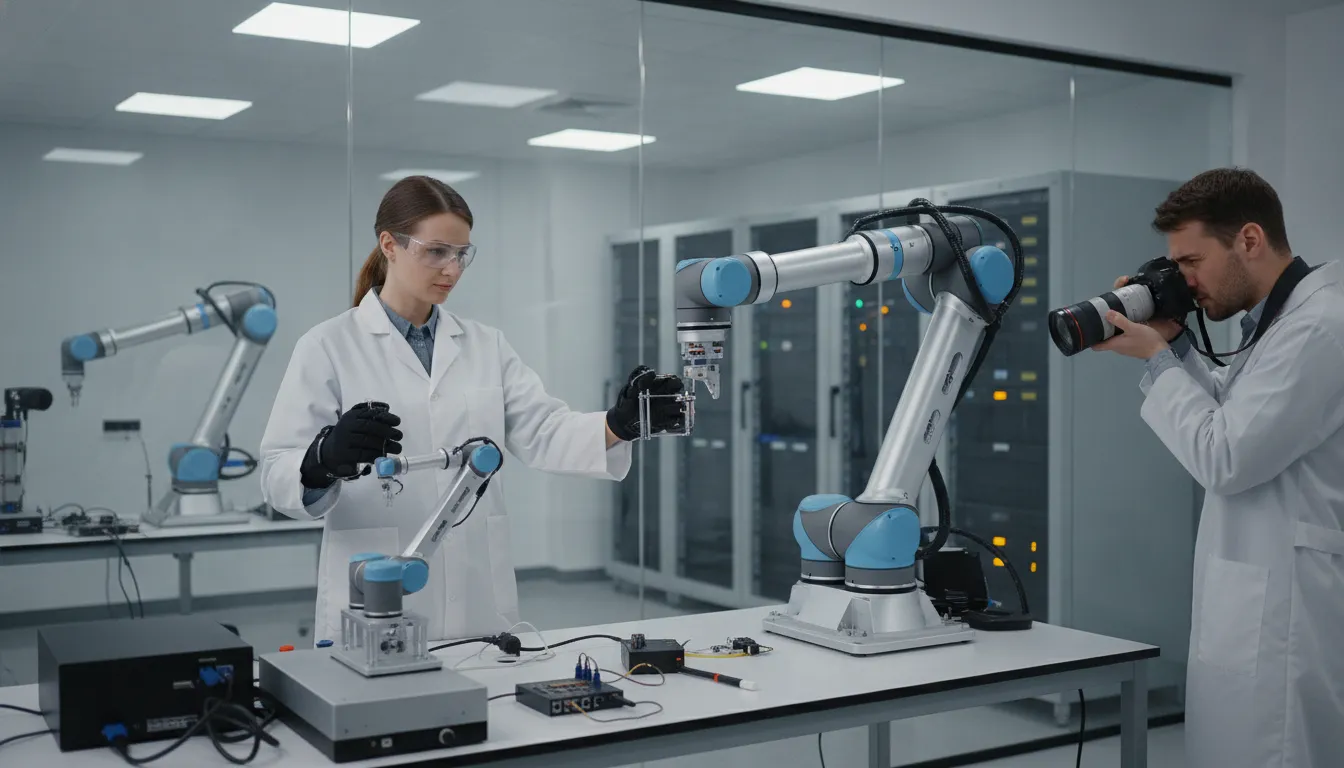
Summary: Embodied AI needs a seamless loop of sensing, thinking, and physical action. By using research-grade robotic arms, mobile platforms, and teleoperation hardware, teams can collect real-world joint and camera data. This data is used to train and run neural networks right in physical space.
Robotic arms and manipulation
Robotic manipulation is a major pillar of embodied AI. To teach a machine how to grasp, sort, or fold, research labs use real robotic arms. These advanced AI robotics hardware systems are needed for research groups that study imitation learning. These tasks include jobs like sorting lab vials and packing shipping boxes. Instead of building arms from scratch, teams buy ready-to-use platforms. By using pre-built arms, labs can focus their effort on writing better code. This approach helps teams start training models in hours rather than months.
Mobile platforms for spatial learning
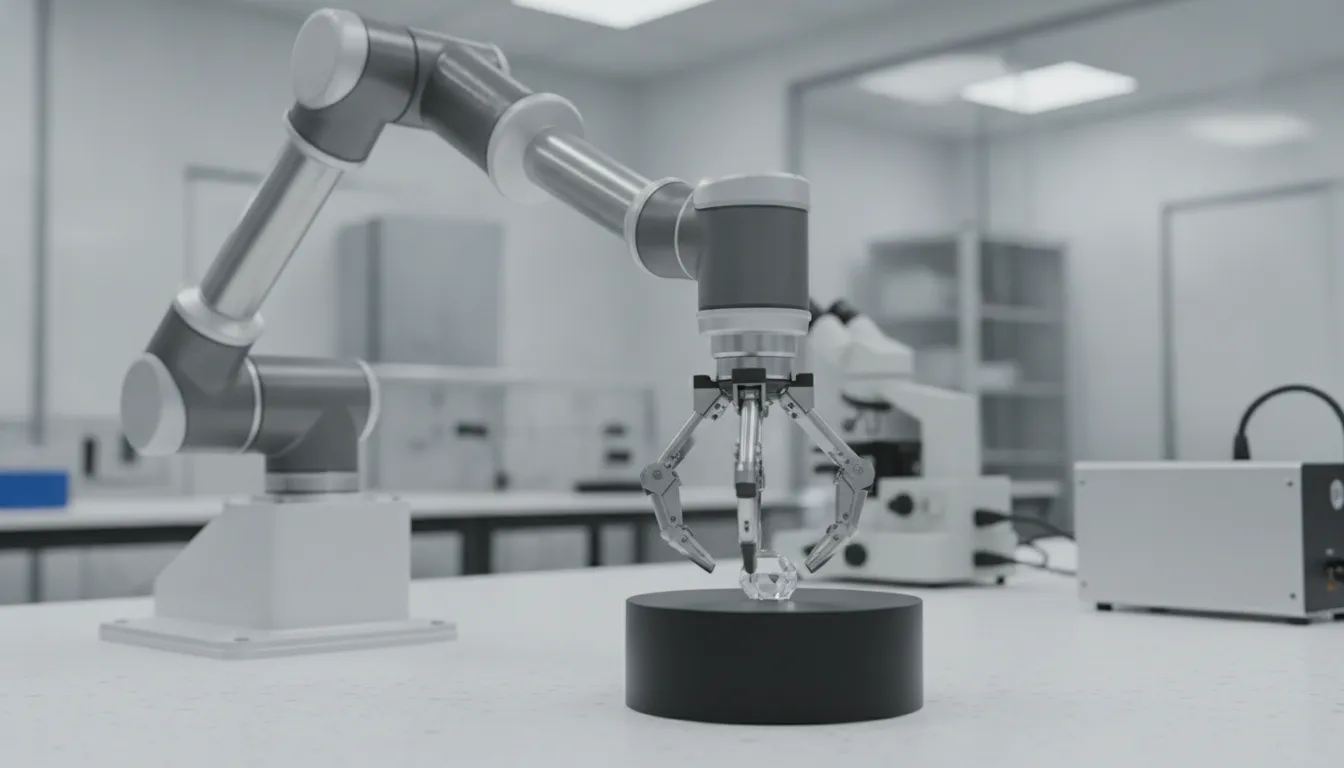
Embodied AI must also travel through and deal with large, changing settings. Mobile AI platforms combine wheels or legs with cameras and computers to help robots move. A mobile robot uses its onboard sensors to map out rooms and find paths. This helps the system avoid moving objects like people or carts in real time.
To build good models, teams often test them in virtual setups first. Studies on PubMed show that sim-to-real transfer is key for this task. It helps robots learn how to cope with new spaces. Once the virtual tests succeed, teams move the model to the real hardware.
Teleoperation and data collection
How do robots get the training data they need to learn? The answer is teleoperation, where a human pilot guides a robot through a task. The human pilot may use a control rig to steer the robot. As the human moves, the robot copies those actions exactly. This direct guidance gives a rich source of real-world training samples. During this process, the robot records its own joint movements and camera feeds. Trossen Robotics provides ready-to-use manipulation systems built for high-quality dataset building at scale. These systems support key embodied AI frameworks like ALOHA, LeRobot, and OpenPi out of the box.
Using these tools, teams can gather a large set of training data. Once the dataset is ready, teams train a neural network to copy the human moves. This is the heart of modern robot learning with the ALOHA project. After training, the model can run on its own.
If you want to see how this works in practice, read our guide on running embodied AI inference on real hardware. This guide walks you through the steps to load and run trained models on small, cheap boards. These small boards can run complex models right on the edge. This setup removes the need for costly extra computers. It makes the system much more useful for real-world jobs.
Get a custom quote on ready-to-use platforms today. Contact Trossen Robotics to start building your custom data pipelines.
Building the Data Pipelines That Power Embodied AI
Answer: Embodied AI relies on steady data pipelines. These pipelines record joint states, capture multi-camera feeds, and merge simulated and real data to train robotic models.
Embodied AI needs massive amounts of real-world data to learn. The training starts with capturing exact physical actions. We must track how a robot moves and what it sees at the same time.
Without high-quality logs, models cannot map perception to action. Real physical trials are the only way to capture the friction, slip, and weight of the real world. This process creates the base for smart physical systems.
High-speed data capture on physical systems
To train robot models, you need fast and precise data capture. Our systems support high-frequency joint state recording at 200 Hz along with synchronized multi-camera streams.
This means the robot saves its position two hundred times every second while capturing clear video. Even minor delays can disrupt the model. Accurate recording ensures that the policy learns the exact link between sight and force.
This level of speed is key for imitation learning. It allows researchers to capture fine human hand movements during teleoperation. These pipelines give the data needed for closed-loop interaction in complex and changing environments.
When you use advanced AI robotics hardware, this high-speed stream feeds directly into your neural network. This setup makes it easy to start modern robot learning with the ALOHA project.
Merging real and synthetic datasets
Collecting real data takes time and effort. To scale up, labs often mix real data with simulated data. Synthetic data generated from digital twin simulations can be used alongside real-world data to train multimodal physical AI models.
Using digital twins lets you run thousands of virtual tasks in minutes. This allows you to test edge cases that are too rare or dangerous to try in real life. Simulation helps fill the gaps in physical datasets.
This hybrid method is the best way to get robust datasets. By combining simulation and physical trials, you prepare your model for the unexpected. We enable high-quality dataset generation for robotics at scale.
Our tools help you clean, label, and structure these mixed streams so they are ready for training. This structured data allows models to generalize well. When your pipeline is smooth, you can focus on building better physical AI.
Get started today by requesting a custom quote on our data collection platforms to scale your physical training data.
From Experiment to Deployment: A Path for Research Teams
Answer: Trossen Robotics offers ready platforms that help research teams move from testing to deployment in hours. By removing barriers to work and giving lifetime support, we help you focus on code, data, and models rather than building hardware.
Moving a robot project from a simple test to a real-world task can take a lot of time. Many teams spend weeks or months just trying to build their systems. We want to stop this delay. Our practical physical AI stack removes these barriers to help you succeed faster.
A complete development workflow
A great project in real-world applications of embodied AI needs a clear workflow. This work starts with strong hardware that allows easy teleoperation. Next, teams must collect clean data from real runs. They use this data to train their models. Then, they test and run them in the cloud.
We support every phase of the robotic workflow:
- Hardware:
Ready systems built for lab research.
- Data capture:
Quick recording of robot joints and video feeds.
- Teleoperation:
Guided collection that turns human demonstrations into reusable training samples.
- Training:
Systems that run modern learning models with ease.
- Evaluation:
Tools to test learned policies in simulation before real deployment.
- Deployment:
Cloud-connected infrastructure that moves models from experiment to scale.
A repeatable path from experiment to deployment follows four steps:
- Set up hardware:
Use a ready-to-use arm or mobile platform so your team starts collecting data in hours.
- Collect real-world data:
Capture high-frequency joint states and synchronized camera streams through teleoperation.
- Train the model:
Blend real and simulated data to teach the neural network in a virtual or cloud environment.
- Deploy and refine:
Run the trained model on physical hardware, then use feedback from real trials to keep improving it.
Building all these steps from scratch is hard. Many research groups waste time on custom parts. This slows down progress and delays real-world testing. We focus on removing barriers for innovators so you can skip the setup phase. Our ready-made tools let you get up and run in hours instead of weeks or months.
Lifetime engineering support
We do not just sell a robot arm and walk away. Trossen Robotics provides lifetime engineering support for all our systems. This is part of the Trossen Promise to keep your team working without pause. If a joint fails or a camera stream drops, our experts are here to help you fix it.
With this support, your group can master Sim-to-Real transfer. This process lets you train a brain in a virtual world and run it on a real machine. Our tools are built to make this process smooth. You get the benefits of a full robotics lab with none of the usual setup pain.
Frequently Asked Questions
How do researchers use simulation to train physical robot models?
Researchers use virtual worlds called digital twins to train robots. According to NVIDIA, digital twins are physically accurate replicas of real settings. These virtual spaces let developers create large amounts of synthetic data. Teams combine this virtual data with real-world data to train deep models. This helps robots learn skills safely in a virtual space. Then, teams transfer those skills to physical machines through a process called sim-to-real transfer.
Why is high-frequency joint state recording important for robot learning?
Robots learn physical skills by watching and repeating human actions. To capture fine movements, systems must record joint positions very fast. High-frequency joint state recording at 200 Hz allows the robot to catch tiny changes in speed and force. These high-speed streams provide the high-quality dataset generation needed to train deep models. According to Trossen Robotics, this high rate ensures that the physical AI models get smooth, precise data during training.
Which software frameworks support out-of-the-box embodied AI?
Several open-source software tools help researchers train physical robots. Key frameworks include ALOHA, LeRobot, and OpenPi, which support advanced robot learning. These tools provide pre-built training loops, dataset tools, and model libraries. According to Trossen Robotics, using ready-to-use platforms that support these frameworks out-of-the-box lets research teams run real-world tests in hours instead of months. This removes the main setup barriers so innovators can focus on deep learning code.
How does the embodied Turing test differ from the standard Turing test?
The standard test focuses on uniquely human skills like language and game playing. In contrast, the embodied Turing test focuses on skills shared with all animals. According to research in Nature, this test challenges AI models to interact with the physical world. It measures how well a system performs real-world actions like vision and movement. These basic physical skills are inherited from over 500 million years of animal evolution.
Are You Ready to Accelerate Your Embodied AI Research?
Building a custom hardware platform for physical AI from scratch is a slow, expensive process that delays your overall progress. Your team can easily waste months of valuable research time sourcing various components and troubleshooting basic mechanical integration issues. By choosing a ready-to-use, research-grade robotic platform today, you can skip the complex engineering setup work entirely. Our fully integrated systems allow your researchers to start collecting high-frequency joint state data on day one. This speeds up your development timeline and lets your team focus on training core machine learning models.
Ready to build? Contact us today to talk with our robotics team about an embodied AI platform that fits your research needs.
Comments